As told by: Patient Lao Chen
I am Lao Chen, and I am 79 years old this year. In the past, if someone had told me that a person nearing 80 could still fight cancer for two years, I would never have believed it. But now, I sit in the yard every day basking in the sun, watching my wife tend to the flowers and plants, and I feel especially calm inside. Not long ago, I would not even have dared to imagine days like these.
The disease came without any warning at all. In early spring 2023, I kept feeling a dull pain on the left side of my waist, especially at night, and I had to go to the bathroom frequently. I thought it was just kidney stones acting up with age and did not take it seriously. Later, I had a CT scan at a local hospital, and the doctor's expression changed after reading the images. Then a cystoscopy sample was taken for testing - bladder cancer, invasive, already grown into the muscle layer. When I heard the word 'cancer,' my mind buzzed, and I could no longer take in anything the doctor said afterward. I had always been fairly strong for my age. How could I suddenly have this disease?
But when illness comes, you cannot just lie down and wait. In April that year, I underwent laparoscopic surgery. My bladder was removed, and both ureters were rerouted to an abdominal stoma for urine drainage. It was a major operation, and I gritted my teeth and got through it. After surgery, I had six rounds of targeted therapy plus immunotherapy, thinking that I could finally breathe a little easier. Who would have thought this disease was like weeds in a field: you think you have cleared them, and as soon as the wind blows, they sprout again. In April 2024, I felt a small lump on the left side of my abdominal wall. CT and PET-CT showed metastasis. Not long afterward, something was also found in my right lung. Then came thoracoscopic surgery and a local-anesthesia excision of the abdominal wall. The pathology all showed metastatic squamous cell carcinoma. By June, three more hard lumps had appeared beside the stoma, and they were removed again. Chemotherapy followed. I received albumin-bound paclitaxel three times, but the nausea, loss of appetite, and total weakness were too much for me, so I stopped.
At the follow-up in November, the metastatic lesion in my lower left abdomen had grown again; on the scan, it was more than 5 centimeters. Recurrence after recurrence, operation after operation - I was truly exhausted. Another major open abdominal surgery? At 79, I could not bear it. Radiotherapy? The location was unsuitable, and I was afraid of the side effects. During that period, I really had no confidence and did not know what road was still ahead of me.
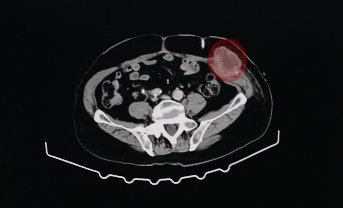
Preoperative CT imaging shows a lesion in the abdominal wall (highlighted in red).
My daughter asked around everywhere and finally learned about Chengdu Huanya Hospital, a high-end hospital specializing in minimally invasive tumor treatment. She heard that it had some of the country's leading experts, including Professors Zhang Jinshan, Xiao Yueyong, and Liao Zhengyin, all well known in the field of minimally invasive tumor therapy. Most importantly, they could perform 'cryoablation' - no major surgery, just inserting a fine needle into the tumor and freezing the cancer cells to death. My daughter said to me, 'Dad, let's go and have a look. Even one more hope is worth seeing.'
In mid-December 2024, I was admitted to UNI-ASIA Cancer Hospital. As soon as I entered the front door, I was a little stunned - it did not feel like a hospital. There were no noisy lines, no sharp smell of disinfectant; it was quiet, clean, and felt as comfortable as coming home. I had a stoma on my abdomen, and the nurses and coordinators from the International Department stayed with me throughout, helping with procedures, fetching things, and arranging everything properly. In the lobby, I could see patients of different skin colors, and I thought to myself: this hospital really is different.
After I settled in, Professor Liao Zhengyin, who would perform my procedure, came to see me. He did not rush into the treatment plan. Instead, he pulled up a chair and sat beside me, brought up the CT images, pointed to the black, white, and gray area on the screen, and said, 'Lao Chen, look, this is what we need to deal with. It is under the abdominal wall and not very deep, which makes it very suitable for cryoablation. I will use a very fine needle, guided precisely by CT and ultrasound, to reach the lesion. The temperature at the needle tip will drop to more than 100 degrees below zero, freezing this area into an ice ball and allowing it to necrose on its own. The surrounding healthy tissue is basically unaffected, the wound is small, and recovery is quick.' As he explained, he gestured and drew me a simple diagram. I asked several questions, and he answered patiently until I truly understood. At that moment, more than half the weight in my heart was lifted - it turned out that not every treatment had to involve opening up the abdomen.
The procedure was scheduled for the next afternoon. Professor Liao and the nurses kept chatting with me, helping me slowly relax. After the local anesthetic was given, I felt a fine needle pass through the surface of my skin. On the ultrasound and CT images, the needle tip could be seen approaching the tumor bit by bit. Once freezing began, only that area felt slightly cool. The nurses used warm water to protect the nearby skin and kept asking whether I felt comfortable. A little over an hour later, the dressing was finished, and I was sent back to the ward fully awake.
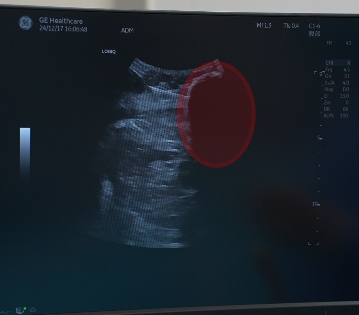
Intraoperative ultrasound shows a lesion in the abdominal wall (highlighted in red).
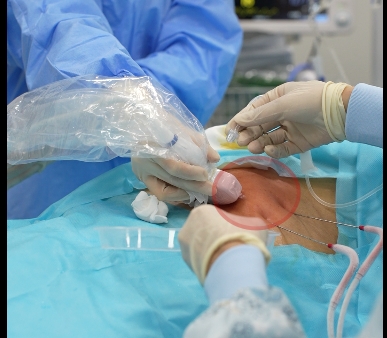
During the procedure, argon-helium cryoablation needle placement was performed on the lesion (highlighted in red).
When I woke up the next morning and moved my body, the wound only ached faintly. Compared with the pain of previous surgeries, it was almost nothing. That afternoon, I could get out of bed and slowly walk while holding the bedside. The nurses came every day to change the dressing, carefully preventing urine from the stoma bag from touching the wound, and they adjusted my diet to avoid constipation and straining. My blood sugar and blood pressure had been unstable, and the doctors managed those as well. Within just a few days, my energy returned, and on December 21, I was discharged smoothly.
From admission to discharge, it took only five days. As I looked at Professor Liao, the doctors, and the nurses before leaving, I was so grateful that I did not know what to say. I only wanted to say: 'Thank you. When I felt there was almost no way forward, you gave me another choice and spared me so much suffering. Coming to this hospital was the right decision.'
Finally, I want to say to other patients: do not be afraid. Cancer does not appear in a day or two, and treating it is not limited to just one path. Ask more, look more. I found this minimally invasive option - with smaller trauma and faster recovery - and it helped me get through this hurdle. If I, nearly 80 years old, could make it through, you can too.
This case is based on a real patient experience, with privacy details processed. It does not constitute a treatment promise.