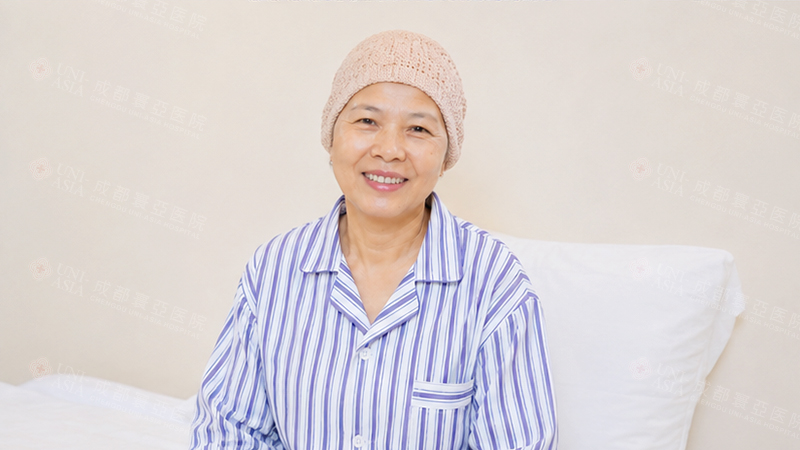
— A cross-border minimally invasive treatment record of a young Indonesian mother
My name is Amira. I am from Indonesia, 35 years old, and the mother of two children. Two years ago, my right eye began tearing for no apparent reason. I thought it was only ordinary dacryocystitis. I never imagined that, after many twists and turns, I would be diagnosed with a malignant tumor called alveolar rhabdomyosarcoma. It was growing deep in the nasopharynx and had already invaded the orbit. At that moment, holding the pathology report in my hands, I felt as if I had been hollowed out. I held my husband and burst into tears. I was only in my early thirties, and my children were still so young. How could fate play such a cruel joke on me?
In the days that followed, I gritted my teeth and endured sinus surgery, eight cycles of chemotherapy, and 56 Gy of radiotherapy. The chemotherapy drugs made my hair fall out in handfuls. The nausea and vomiting were so severe that even seeing a cup of water made me tremble. I was also left with hearing loss in both ears. Yet fate seemed unwilling to let me go. During a follow-up examination, the doctor said gravely that a new lesion had appeared on the inner side of my right orbit: the tumor had recurred. Because it was so close to the optic nerve and eyeball, another surgery would be extremely risky, almost equal to giving up that eye. The despair I felt then was like being locked in a windowless room, where even breathing had become a luxury.
While my family was asking everywhere for help, a fellow Indonesian working in Chengdu mentioned UNI-ASIA Cancer Hospital. He said it brought together top Chinese minimally invasive interventional experts such as Zhang Jinshan, Liao Zhengyin, and Xiao Yueyong, specializing in difficult tumors that were considered 'inoperable.' We quickly contacted the hospital's International Department and were connected with a Russian-speaking coordinator, who helped arrange a remote video consultation. On the other side of the screen, Professor Liao Zhengyin carefully reviewed all of my imaging materials and told me, 'Don't be afraid. We can help you. With minimally invasive interventional technology, we can identify the artery supplying the orbital tumor and deliver the medicine precisely into it, just like watering only the weeds with poison while sparing the good seedlings.' He also said that tiny radioactive seeds could be implanted later to continuously irradiate the tumor from within. Hearing this, I felt as if a crack of light had opened in the wall of that dark room.
Everything that followed went very smoothly. The hospital helped us apply for visas to China. As soon as the plane landed in Chengdu, a coordinator was waiting at the airport holding a name card in Kazakh and took thoughtful care of us all the way. The moment I entered the ward, the private and quiet room, the soft greenery outside the window, and the Russian-language Chengdu guide thoughtfully prepared on the table gave me an immediate sense of being 'at home.' On the day of treatment, I did not have to lie on a cold operating table again. Instead, I walked into the interventional room on my own. After local anesthesia at the root of my thigh, I remained awake and could feel Professor Liao's extremely gentle technique. The catheter moved through my blood vessels, and the dark shadow on the screen gradually faded as if by magic. In less than an hour, I returned to the ward calmly and smoothly, without even the vomiting that had tormented me so much during previous chemotherapy. Because the nursing team worried about the swelling and discomfort in my right eye, they came every so often to apply cold compresses. The nutritionist even prepared yogurt and pilaf close to the taste of my hometown. In a foreign country, this warmth brought tears to my eyes.
On the third day after the minimally invasive treatment, more than half of the swelling, pain, and redness around my right eye had subsided. Wearing an eye patch, I could already sit by the bed and video call my children on my phone. One week later, I successfully underwent iodine-125 seed implantation at UNI-ASIA Cancer Hospital's Zigong campus (Zigong High-Tech Cancer Hospital), with only mild swelling throughout the procedure. On the day I was discharged, the winter sunshine in Chengdu was warm. I deliberately walked to the hospital entrance and took a deep breath. For the first time in two years, every breath felt light.
Finally, I want to sincerely thank Professor Liao Zhengyin of UNI-ASIA Cancer Hospital and his medical team. You not only saved my eye with the thinnest of catheters; with compassion that crossed national borders, you also gave me the courage to imagine once again a future in which I can watch my children grow up. I also want to say to those still struggling on the road of fighting cancer, as I have: we Kazakhs believe that no matter how fierce the snowstorm on the grassland may be, it cannot stop the footsteps of spring. Modern minimally invasive technology is like a sure-footed steed that can carry us around the blade and more quickly toward rich pasture and clear water. Do not be frightened by words such as 'advanced stage' or 'recurrence.' Choose the right guide, and hope is never far away.
— Dictated by Amira · Under a ray of warm sunlight before discharge in Chengdu
This case is based on a real patient experience. Privacy details have been processed. It does not constitute a promise of diagnosis or treatment.