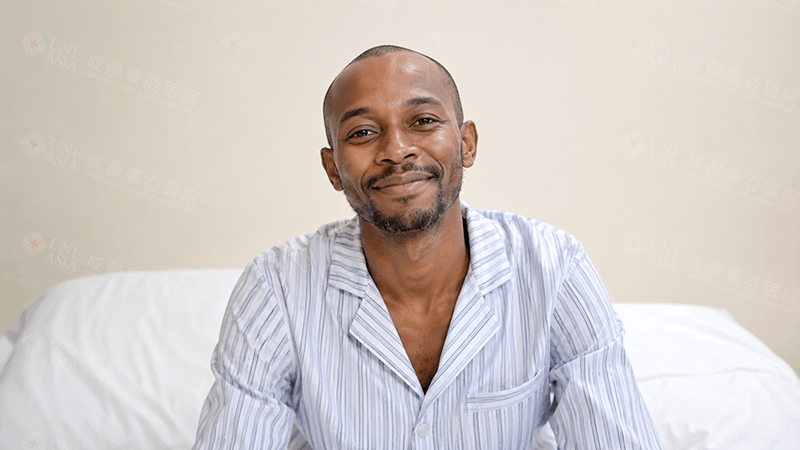
My name is Catia (KATIA). I am forty-two years old and come from the Philippines. I am an ordinary farmer and the father of two children. If it had not been for the vague pain in my upper right abdomen more than a year ago, my life might have continued to flow quietly with the rising and setting of the sun. At first, I thought I was simply tired and that a few painkillers would help me get through it. No one expected that it would be the beginning of a nightmare. Two months ago, the pain suddenly intensified, as if an invisible hand were fiercely gripping my liver. The diagnosis from the local doctor struck me like a dull thunderclap: primary liver cancer, already accompanied by intrahepatic metastases, with a tumor thrombus in the inferior vena cava; the disease was stage IV. I was completely stunned. What I feared was not death itself, but the possibility that I would no longer be able to watch my two children grow up.
The treatment journey that followed was full of setbacks. At a local hospital, I received liver-protective treatment and treatment to reduce jaundice, but the results were not good. My skin and eyes turned alarmingly yellow, my abdomen was swollen like a drum, and my legs were so swollen that pressing on them left pits. That feeling was unbearably tormenting. It was not only the physical pain, but also the despair of watching myself being swallowed by the disease day by day while being powerless to stop it. I have always been someone who can endure hardship, but during that period, I was truly close to breaking down. Because the stage was too advanced, I had already lost the chance for surgery. I even secretly thought that perhaps I should just give up.
My family refused to accept this and searched everywhere for options. Finally, through a referral center in the Philippines, they found Chengdu Huanya Hospital. The staff at the referral center introduced it as a high-end private hospital in China specializing in minimally invasive cancer treatment. Without major open surgery, they said, tumors could be targeted precisely. The hospital also brought together several top interventional experts in China, such as Professor Liao Zhengyin and Professor Luo Xiaoping, whose names are well known in the field. This news was like a beam of light that rekindled the flame that was almost extinguished in our hearts. We soon contacted the hospital. What surprised me most was that from the moment I decided to go to China for treatment, I no longer had to worry about the arrangements. From preparation before entry to admission after landing, the hospital arranged dedicated staff to serve us around the clock. The accompanying multilingual coordinator communicated with me in fluent English. That sense of being properly cared for in a foreign country eased my tense nerves considerably.
On the day I was admitted, I was pushed into the ward on a stretcher. There was no pungent smell of disinfectant, no noisy and crowded corridors. The ward was private and warm, with soft light coming in through the window. The attending doctors and nursing team were already fully prepared the moment I appeared at the ward entrance. What truly helped me feel reassured was the arrival of Director Luo Xiaoping. After reviewing the thick stack of examination reports I had brought, he did not begin with complicated medical terminology. Instead, he picked up a pen and paper, sat beside my bed, and explained everything in the simplest words while drawing: “Look, the tumor in your liver is large and it is blocking the pathway for bile drainage, which is why your whole body has turned yellow. Our first step is to use minimally invasive interventional surgery to drain out the blocked bile and make you feel better.” He drew a simple diagram of the liver and bile ducts on the paper, marked the location of the lesions, and explained patiently, as if teaching a primary school student. At that moment, I suddenly felt that perhaps there really was still a turning point for my illness.
Every step of the treatment allowed me to understand what a “people-centered minimally invasive philosophy” truly means. On the second day after admission, Director Luo Xiaoping personally performed DSA-guided percutaneous transhepatic biliary drainage catheterization for me. There was no large incision—only a small puncture under local anesthesia—and golden-yellow bile was drained out. After the procedure, my abdominal distension was immediately relieved to a considerable extent. However, my condition was extremely severe, and acute renal failure and peritonitis followed one after another. My creatinine and urea nitrogen levels kept rising. Director Luo Xiaoping’s team did not give up. While providing fluids, diuretics, and anti-infection treatment, they urgently contacted nephrology specialists for consultation. The nursing team was even more meticulous. Knowing that I had a poor appetite and could not eat much, the nutritionist specially prepared a nutritional support plan. Every time the nurses came to change my dressing, they would gently pat the back of my hand and speak to me in fluent English to ease my anxiety. Those little moments of warmth supported me through the most difficult stage.
After my condition became slightly more stable, another week passed. Director Luo Xiaoping and Director Wu Chaobo then performed percutaneous femoral artery puncture, hepatic arteriography, catheter-directed infusion chemotherapy, and embolization for me. As they explained it to me, the general idea was to guide a catheter all the way into the artery supplying blood to the liver, deliver chemotherapy drugs and embolic agents directly and precisely into the tumor, block the tumor’s nutrient supply, and release medication at the same time. The procedure did not take long. I remained awake throughout and could feel the doctors’ skilled and gentle movements. After returning to the ward, except that the punctured leg needed to remain still and rest, I was able to do ankle exercises and walk appropriately under the nurse’s guidance the next day. Compared with what I had heard about traditional surgery, where patients often need to stay in bed for weeks, this speed of recovery was simply worlds apart.
After another period of recovery, the doctors told me I could be discharged. At the moment of discharge, I tightly held Director Luo Xiaoping’s hand. This expert, always calm and unhurried, with a steady gaze, had eyes full of concern. I had thousands of words in my heart, but in the end they became one sincere sentence: “Thank you. In my darkest moment, you gave me the greatest dignity and hope with the smallest trauma.” I know the road ahead is still not smooth, but my time at Huanya changed me from someone who completely resisted treatment into someone willing to coexist with the disease and fight it step by step.
This case is based on a real patient experience. Privacy details have been modified. It does not constitute a medical treatment guarantee.