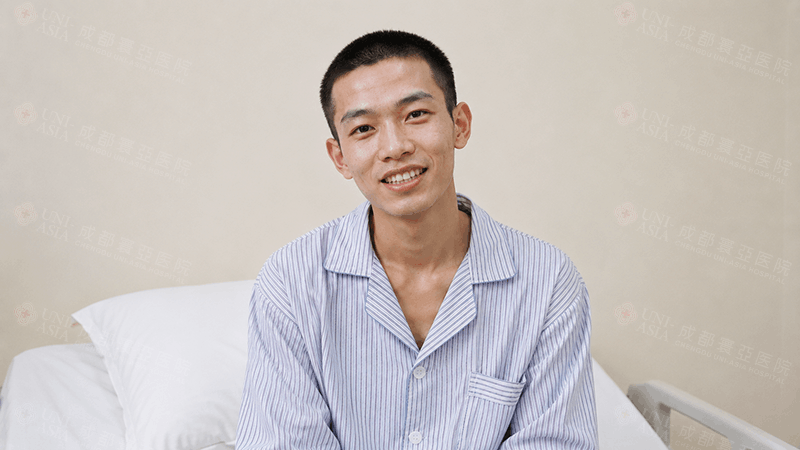
My name is Akun, and I am 34 years old. In September 2025, I began to feel pain in my neck. At first, I thought it was a cervical spine problem from spending too much time on my phone, so I went to a massage shop several times. But the more I had it massaged, the worse it hurt, until eventually I could not even turn my neck. After I went to the hospital for examinations, the doctor said there was a growth on my liver, most likely malignant, and that it had already spread to my cervical spine.
I was completely stunned. I was only 34. Liver? Neck? Cancer? How could those words have anything to do with me? I then went to several large tertiary hospitals and had test after test. In the end, I was diagnosed with liver cancer, and the third cervical vertebra had been eroded and flattened by the tumor. During that period, turning my head was impossible; even the slightest movement caused pain. I had to use a wheelchair when going out, could not sleep well, lost a lot of weight, and my overall condition kept getting worse.
In mid-December, my family learned about Huanya Hospital and wanted me to try treatment there. To be honest, with my condition already like that, I felt even before coming that it might be useless. But Professor Liao Zhengyin and Director Zhou Liang told me that, using a minimally invasive method, they could first support the collapsed bone in my cervical vertebra so that I would not be in so much pain. I had hope again. After all, I was still so young. I did not want to stay in a wheelchair forever, and I did not want to keep enduring that kind of life.
The first procedure was on my neck. The doctors explained that they would insert a very fine needle through my neck to the collapsed area of the cervical vertebra and inject a small amount of “cement” to support the bone. I have forgotten the exact details of the procedure. I only remember lying there, awake, while the doctor occasionally said things like “the needle is in” and “the medicine is being injected; it will be over soon,” in a tone as casual as ordinary conversation. The whole process took just over an hour. I lay in the ward for a day after returning. The next day, when the doctor came to see me, I tried moving my neck. The place that had hurt for months suddenly felt much looser. I could finally take off the cervical collar I had worn for months. At that moment, I thought: there really is hope.
One day later, I had the second procedure. The doctor told me that a thin guidewire would be inserted through a blood vessel at the root of my thigh, then guided along the vessels to the tumor in my liver, delivering medication while blocking the route of its blood supply. Because the first procedure had gone so well, I felt much more at ease this time. The surgery went even more smoothly than expected. The doctor said there were three blood vessels supplying the tumor in my liver, and they had all been treated thoroughly. After the procedure, when I returned to the ward, I did not feel much discomfort. I simply lay with my leg straight for a few hours as instructed. On the third day, the nurse said I could try getting out of bed and walking. My wife could hardly believe it: “You don’t look like someone who just had major surgery at all.”
During the ten-plus days in the hospital, there were a few minor setbacks: my abdomen felt bloated and I could not eat. The doctors said it was because I had been lying down for too long, my intestines were not moving well, and there were also reactions to the medication. They encouraged me to walk around when I could, and the nurses applied warm fennel packs to my abdomen. Gradually, things improved. There was some pain too, but it was not severe, and with the doctors’ help it was quickly relieved.
By the time I was discharged, my neck had completely returned to normal, and I could walk steadily. Compared with the state I was in when I was admitted, curled up in a wheelchair, it was almost like I had become a different person. Director Liao also gave me many detailed instructions to follow.
Now I am back in my hometown. I eat and sleep normally every day and sometimes go out for walks. Neighbors say I look much better. I still need to continue treatment, but I no longer feel panicked. People are not afraid simply because they are ill; what is frightening is not knowing which way to go. Thank you, Huanya Hospital. Thank you, Professor Liao. Now I can see this road clearly, and I will keep walking it step by step.
This case is based on a real patient experience. Privacy details have been processed. It does not constitute a promise of diagnosis or treatment outcomes.