
- Patient Stories
- Zhao Guodong
Advanced Colorectal Cancer with Multiple Metastases – Four Interventional Procedures Gave Me a New Life
My name is Zhao Guodong, I'm 58 years old, and I live in a small county town in Sichuan. To be honest, I've never been particularly talented at anything in this life—but I've always been good at enduring. When I was young, working in the production brigade, I could carry 200-pound sacks without breaking a sweat. Later, I joined the county farm machinery station as a repairman—crawling under trucks, dismantling engines, and rolling in grease for decades. I smelled like motor oil no matter how much I washed. After retirement, I didn't sit still either. I bought a used pickup truck and made a living hauling goods for people. The neighbors all called me "Iron Man Zhao." I always believed my body was made of iron—it could never break down.
But last winter, this iron body of mine started to fail me.
First came a dull ache under my right ribs, like something was pressing from the inside. I lost my appetite – I could barely finish half a bowl of rice – and I was visibly losing weight. My son asked if I was feeling unwell, but I said it was nothing. Men aren't that delicate. But by the end of the year, the pain got worse. At night, I couldn't sleep, tossing and turning, drenched in cold sweat. My son panicked and dragged me to the local oncology department.
After a contrast-enhanced CT and colonoscopy, the doctor called my son in alone. I sat on a bench in the hallway, staring at that closed clinic door, and suddenly felt a deep dread. When my son came out, his eyes and the tip of his nose were red. He forced a smile and said, "Dad, it's nothing serious. The doctor said they need to run more tests." But I'd raised him for thirty years—I could see through his lies in an instant.
The report read: colon cancer, multiple liver metastases, multiple lung metastases, and enlarged abdominal lymph nodes.
Colon cancer. Liver metastases. Lung metastases. I read each word, feeling like I was drowning, unable to breathe. The doctor said it was already advanced – no surgical options, only radiotherapy and chemotherapy. I sat there, and only one thought kept circling in my mind: my grandson had just started kindergarten. I wanted to watch him grow up.
What followed – the chemotherapy and radiation – was harder than every hardship I'd endured in my entire life combined. As soon as the chemo drugs went in, I felt completely hollowed out—I threw up everything I ate and couldn't even keep down a sip of water. My hair fell out in clumps—on the pillow, on my clothes—so I just shaved it all off. My white blood cell count dropped to nearly undetectable levels. My immunity was so low that a draft through the window could give me a cold. By the end of the radiation sessions, the skin on my abdomen was red and peeling from the burns—even my clothes hurt to touch. But what broke me the most was that after all that suffering, the follow-up results were devastating—the lesions hadn't budged, and the tumor markers were still sky-high. The doctor said the treatment wasn't working well, and my physical condition had deteriorated to the point where I couldn't continue.
During that time, I lay in bed at home, staring at the ceiling from sunrise to sunset. My son didn't say much, but I knew he cried behind my back. One night, I woke up half-asleep and heard him on the balcony, whispering through a phone call, his voice cracking: "If my dad dies... what do I do?" I bit down on my blanket, holding back any sound, but tears soaked my pillow. I, Zhao Guodong, had never shown weakness in my life, but those days, I truly felt like the sky was falling.
The turning point came this spring. My son somehow found out about a hospital in Chengdu called Uni-Asia Cancer Hospital, specializing in minimally invasive interventional oncology. They had gathered a team of nationally renowned interventional experts, and many advanced-stage patients who had been told "there's no hope" elsewhere had found a way out there. He told me about Professors Liao Zhengyin and Zhang Jinshan—they used a method that didn't require open surgery. A very thin tube was put in through the groin, guided through the blood vessels to the artery that supplies the tumor, delivering medicine right to the spot and then blocking the vessel. It was called "arterial interventional therapy."
"Dad, this doesn't require surgery. It's much less damaging to the body." My son held his phone up to me. "Look – so many patients with multiple metastases just like yours, and after a few treatments, their tumors shrank. "
I stared at those case stories on the screen for a long time. The dying flame in my heart seemed to have a little oil added to it.
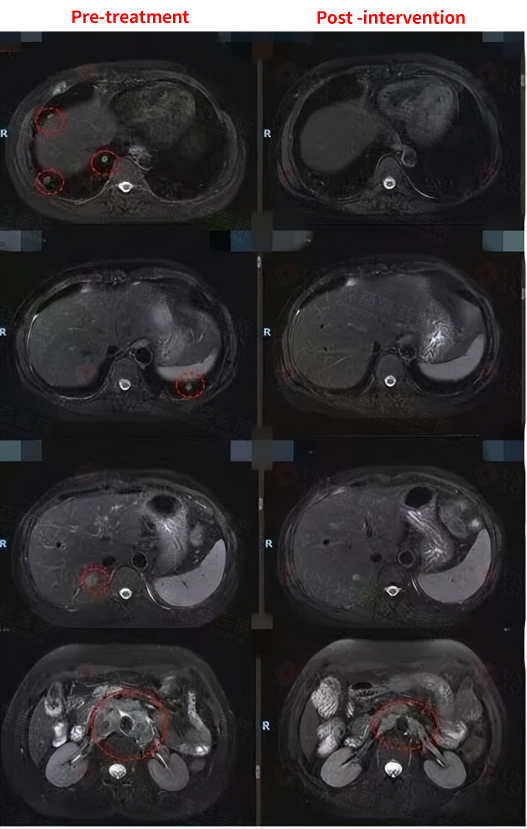
Image caption: MRI comparison at initial diagnosis vs. after all treatments, showing that the tumor lesions had essentially disappeared.
The day I arrived at Uni-Asia Cancer Hospital, Professor Liao Zhengyin carefully reviewed all my films and lab reports from my hometown hospital and arranged for more detailed examinations. He gathered multidisciplinary experts for an MDT discussion specifically for my case. Afterward, Professor Liao patiently explained to me with a diagram, "Master Zhao, your condition is indeed complex—both your liver and lungs have metastases. But after carefully analyzing the blood supply to these lesions, we found that they can be precisely targeted via arterial intervention. We'll do it in four sessions, each targeting different areas, like pulling out nails one by one. The drug will be delivered directly into the tumor at concentrations dozens or even hundreds of times higher than systemic chemotherapy but with much less impact on the rest of your body—which is why you couldn't tolerate chemo before, but you'll be able to tolerate this."
"Four sessions? Can I make it through?" I hesitated.
"Look – your previous chemo reactions were so severe because the drugs went everywhere. Now we're delivering them right to the doorstep of the tumors. You'll suffer much less," Professor Liao said. "Don't worry – we'll be with you every step of the way."
I nodded. Since there was a path forward, I'd walk it. I've repaired thousands of machines in my life. This machine called "my body" deserved a proper fix too.
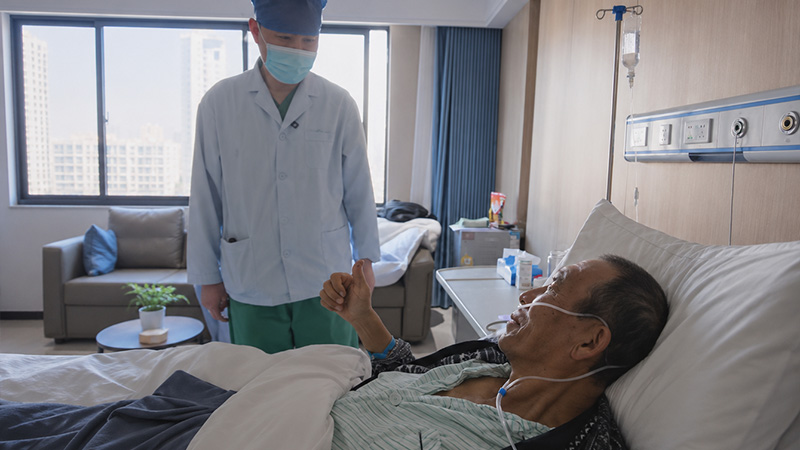
For the first interventional procedure, my son helped me walk into the procedure room. I was nervous, but Professor Liao and his team put me at ease. They kept talking to me softly as they worked—telling me where the catheter had reached, when they were starting the infusion, and when that step was done—their voices steady and calm. In less than an hour and a half, I was wheeled back to my ward with a small gauze dressing on my groin. Aside from a mild fever and slight nausea that evening, I had no other discomfort. The next morning, I could actually sit up on my own and eat a bowl of congee—something I couldn't have dreamed of during chemotherapy.
The second, third, and fourth sessions went more smoothly each time. After every session, I could visibly feel myself getting better. The dull ache under my right ribs gradually faded. My appetite returned – from barely sipping congee to eating half a bowl of rice with some pickled vegetables. My weight, which had bottomed out at around 70-something jin (35 kg), slowly started climbing back. What surprised me most was that one day, looking in the mirror, I saw color in my face—that normal, healthy flush—which I hadn't seen in a long time.
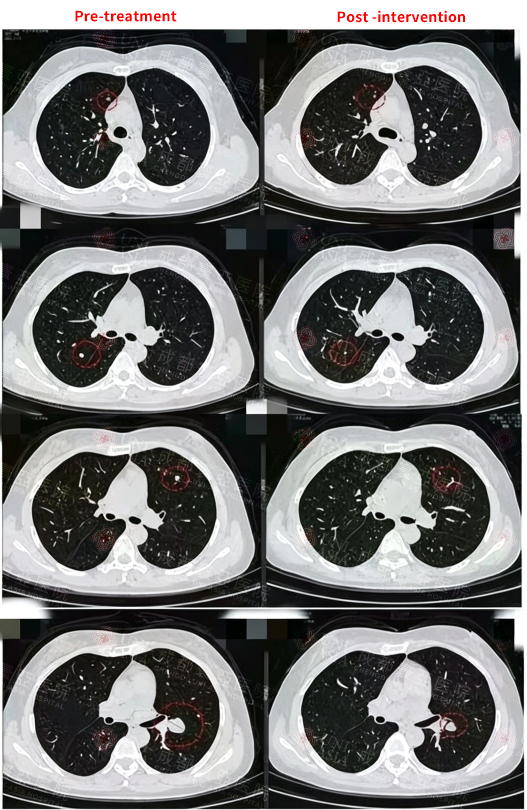
Image caption: CT comparison at initial diagnosis vs. after all treatments, showing that the tumor lesions had essentially disappeared.
After all four sessions were completed, Professor Liao hung my pre- and post-procedure CT images side by side on the lightbox. He pointed at the screen and said, "Master Zhao, look here—these several metastatic lesions on your liver, the largest of which was about 3 cm, are now essentially invisible. The nodules in your lungs have shrunk by over 80%, and most have disappeared. Your tumor markers have dropped from several hundred before treatment to the normal range."
I stared at those two rows of black-and-white images, and tears streamed down my face. Not because I was in pain—but because I was overjoyed, grateful, and relieved. For the first time in over six months, I realized that the "terminal" verdict was not the end.
Now I'm recovering at home. Every morning, I go to the park for a couple of laps, play chess, and chat with old neighbors and come home to play with my grandson. When the little guy throws himself into my arms, yelling, "Grandpa! Grandpa!" my heart just melts. My son says I've become a different person – no longer that haggard, despairing old man, but back to the cheerful, loud-voiced dad I used to be.
A few days ago, I ran into an old colleague from the farm machinery station at the vegetable market. He was shocked: "Guodong, you look great! I heard you were..." He stopped mid-sentence. I smiled and said, "Got fixed up. Found the right place, found the right mechanic."
Looking back on this journey – from being told I was terminal to now living a stable, peaceful life – the tears I shed and the sleepless nights I endured are known only to me. When I used to repair trucks at the station, I knew that if an engine seized or a transmission stripped, as long as you found the right repair method and replaced the right parts, it could still roar back to life. The same goes for people. My old engine, Zhao Guodong, was almost scrapped on the roadside. But Uni-Asia Cancer Hospital—Professor Liao and his team—helped me fix the most critical failure. For the days ahead, I need to live well—to be worthy of this second chance I was given.