

- Patient Stories
- Nguyen Thi Mai

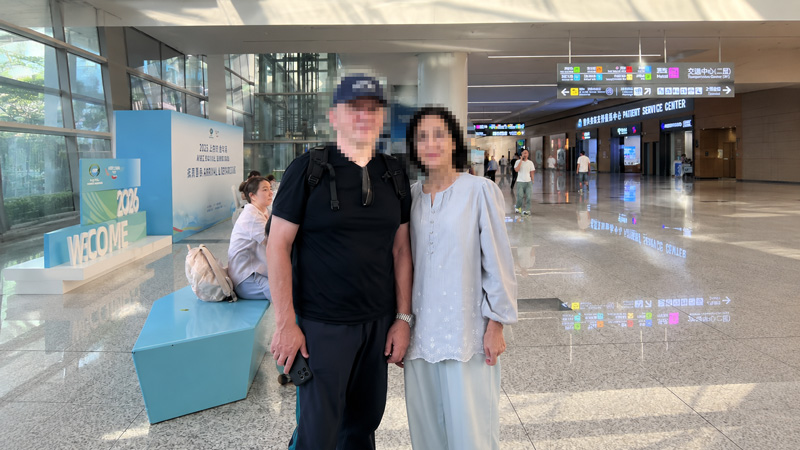
A Thin Tube Pulled Her Back from the Brink of Despair
Nguyen Thi Mai is a 59-year-old from Vietnam.
In August 2025, eating suddenly became a painful experience. Every meal was followed by uncontrollable hiccups, bloating, and a heavy sensation in her chest, as if stuffed with cotton. At first, she didn't think much of it—just assumed it was her old stomach issues acting up and that it would pass. But this time, the discomfort didn't fade; instead, it worsened day by day.
A few months later, swallowing became increasingly difficult, and her weight began to plummet uncontrollably. Finally, she went to the hospital for a comprehensive examination—and received a devastating diagnosis: a malignant tumor at the junction of the esophagus and stomach, already at an intermediate-to-advanced stage by the time it was found. Even more crushing was the doctor's verdict: due to the tumor's large size and her extremely weakened, emaciated state, she was not a candidate for surgery, radiotherapy, or conventional chemotherapy. In those days, she felt like all hope had been extinguished.
From her baseline weight before illness, she had lost a full 20 kg, weighing just over 45 kg upon admission. She felt completely drained, barely able to lift her legs to walk. Bloating, inability to eat, constant weakness—she later recalled that she truly felt her life was burning out.
The turning point started with a needle prick in the thigh.
In May 2026, accompanied by her family, she traveled to Huanya Hospital in China. On the day of admission, the front desk staff were able to help her fill out forms in Vietnamese and guided her through the entire process. The ward didn't have the harsh smell of disinfectant; there were green plants on the windowsill, and the nurse adjusted the lighting to a warm tone, asking whether she preferred a high or low pillow. She sat on the edge of the bed for a long while, thinking, This doesn't feel like coming to a hospital for cancer treatment—it's more like checking into a carefully tended apartment.
The doctor who received her was Professor Liao Zhengyin from the Interventional Treatment Center. Nguyen Thi Mai remembered that Professor Liao went through all the examination reports she had brought from Vietnam from beginning to end, holding each film up to the light one by one, before finally looking up. He didn't offer empty platitudes like "don't worry." Instead, pointing to the irregular shadow on the scan, he told her: "You see, the problem is here, at the junction of the stomach and esophagus. We won't do major surgery now. We'll go in through a very thin tube from your thigh, navigate to the blood vessel feeding the tumor, deliver the medication, and then block that vessel. The goal is to get you eating again without discomfort." She understood only half of it, but one thing was clear: this doctor wasn't brushing her off as someone with limited time—he was earnestly telling her what would be done next and why.
The treatment plan Professor Liao proposed was something she had never heard of: just a needle-sized puncture at the groin, through which a thin catheter would be guided along the blood vessels to precisely reach the artery supplying the tumor. High-concentration medication would be infused directly, and the feeding vessel would be blocked. This way, the tumor would be both "poisoned" by the drug and "starved" by the cut-off blood supply, while the rest of the body received only a very low concentration of the drug, significantly reducing side effects. At the same time, immunotherapy was combined to awaken her own immune system to recognize and clear any remaining tumor cells.
She grasped the general idea. Though still nervous, she felt she had no other way forward.
What Surprised Her Was the Change from Day One
Professor Liao performed the first treatment himself. Nguyen Thi Mai lay on the operating table, staring at the overhead surgical light, her palms slick with sweat. During the puncture, she felt a light prick at her groin, and Professor Liao said calmly beside her, "The needle is in. You'll feel some pressure. Just don't move and you'll be fine." His tone was just as steady and unhurried as in the outpatient clinic. The whole process went much faster than she had expected. As soon as it ended, pressure was applied to the puncture site for a while, and the bleeding stopped. That same afternoon, she was able to stand for a moment with her family's support. What surprised her most was that the throat blockage that had tormented her for over half a year noticeably eased soon after the treatment.
Subsequent treatments were once a month, each time in the same pattern: a needle puncture in the thigh, a thin tube inserted, and she could get up and move freely that same day. She even felt it was like coming to the hospital for a "minor procedure"—done and back to the ward to rest, and the next day she was as good as new. During her hospital stays, the nutritionist would bring specially prepared semi-liquid meals—porridge mixed with finely minced chicken and vegetables—and she could actually finish an entire bowl. There was none of the vomiting or hair loss she had imagined, and no prolonged bedridden recovery.
Behind the Numbers, a Person Slowly Came Back to Life
After the fourth treatment, the changes became visibly apparent. When she first arrived, even thin porridge was a struggle to swallow; now, semi-liquid foods went down smoothly, with no bloating or pain. When she first arrived, her face was sallow and she gasped for breath after just a few steps; now, her energy had clearly returned, and her voice carried more strength. And the numbers on the scale provided the most compelling proof—from 45 kg upon admission, she gradually climbed to 55 kg, a solid gain of 10 kg.
When Professor Liao made his rounds, he flipped through the latest lab results, glanced at her noticeably fuller cheeks, and nodded: "10 kg—that's no small feat. The tumor has shrunk, and your markers are normal. This is the right path." No excessive sentiment—just a straightforward acknowledgment of a result achieved through everyone's efforts. For an advanced-stage cancer patient who had been nearly depleted, that 10 kg wasn't just fat and muscle—it was the capital for survival, the foundation to keep fighting.
The test results confirmed the improvement: the tumor had visibly shrunk, and tumor markers had dropped from abnormal to normal levels. Professor Liao told her that the efficacy assessment had reached a "partial" response—meaning the tumor was indeed retreating. An advanced-stage patient who had initially been given no surgical options and couldn't even tolerate chemotherapy had come this far with minimal suffering. Those who knew her story called it nothing short of a miracle.
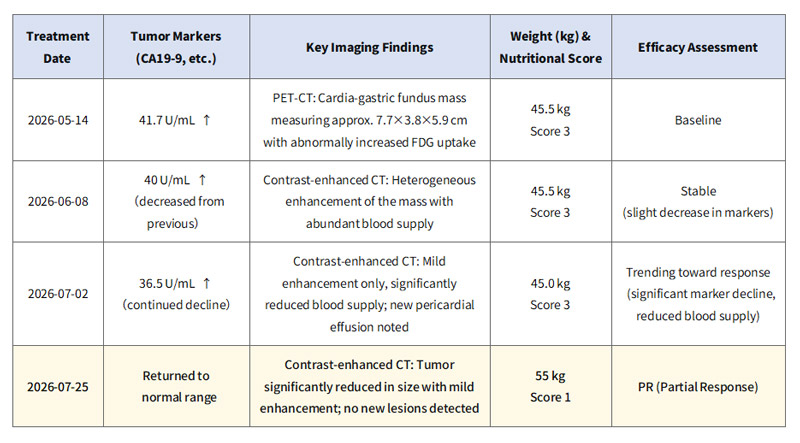
The above presents the changes in key indicators and the evaluation of treatment efficacy during the patient's therapeutic course
"Minimally Invasive"—She Truly Experienced What the Doctor Meant
Throughout the entire treatment process, Nguyen Thi Mai's greatest feeling was that she had hardly suffered at all. Her previous impression of cancer treatment was hair loss, vomiting, and weakness so severe that even water couldn't be swallowed. But this time, what she experienced was after treatment at Huanya Hospital; she could get out of bed the same day, use the restroom on her own, sit and chat with her family, stay in the hospital for just a few days before going home, and eat normally at home. Once, she casually mentioned missing the taste of Vietnamese pho. The next day, a nurse brought her a mild, modified version of rice noodles. She stared at it for a long while, then lowered her head and ate it all, spoonful by spoonful. These small, seemingly insignificant gestures made her feel that she was always being treated as a whole person, not just a medical record.
She later told a fellow patient, "I don't understand the technology. All I know is that Professor Liao and this hospital didn't put me through great suffering—yet my illness has truly gotten better."
Image caption: Comparison of pre- and post-treatment gastric CT scans, showing the lesion has been largely controlled.
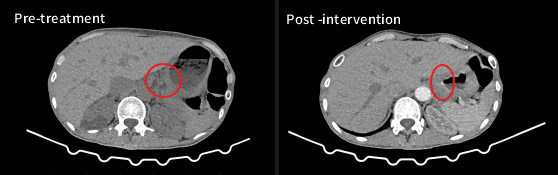
Comparison of pre- and post-treatment gastric CT scans, showing the lesion has been largely controlled.
Turning Despair into Hope – It's Really That Simple
Nguyen Thi Mai's story is also the shared aspiration of many intermediate- and advanced-stage cancer patients—to not suffer too much, to live with quality, and to have a treatment that their body can tolerate and that actually works.
At Huanya Hospital, Professor Liao Zhengyin used a thin tube inserted from the groin to turn that aspiration into reality. No large incisions, no prolonged bedridden recovery, no overwhelming despair. At each treatment, Professor Liao stared at the screen, moving the catheter little by little, like a craftsman perfecting a delicate skill. And everything about the hospital made her feel, for the first time, that seeking medical care didn't have to be so undignified—that she could even retain a measure of composure.
Her journey continues, and treatment is still ongoing. But at the very least, she has gone from a state of staggering weakness and exhaustion to days where she can eat normally, has regained weight, and wears a smile on her face again. For someone who was once told there was "no good way forward," this, right here, is rebirth.