
- Patient Stories
- Tian Yufang

Drained Hollow by Bowel Cancer, I Became a “Medical Tout” for Uni-Asia
My name is Tian Yufang. I’ve just turned sixty. Before I retired, I spent more than three decades working in a textile factory, looking forward to finally enjoying a few easy years. Yet less than two years after I stopped working, a single diagnosis report sent me plunging into a bottomless abyss.
Last spring, I began to have a persistent, dull ache in my belly and noticed blood in my stool. I assumed it was just a bout of hemorrhoids and didn’t think much of it. When two months passed with no improvement, my daughter practically dragged me to the hospital for a colonoscopy. The moment the doctor stepped out, his face was grim. Colon cancer. A sharp buzzing filled my head, and I didn’t hear a single word he said after that.
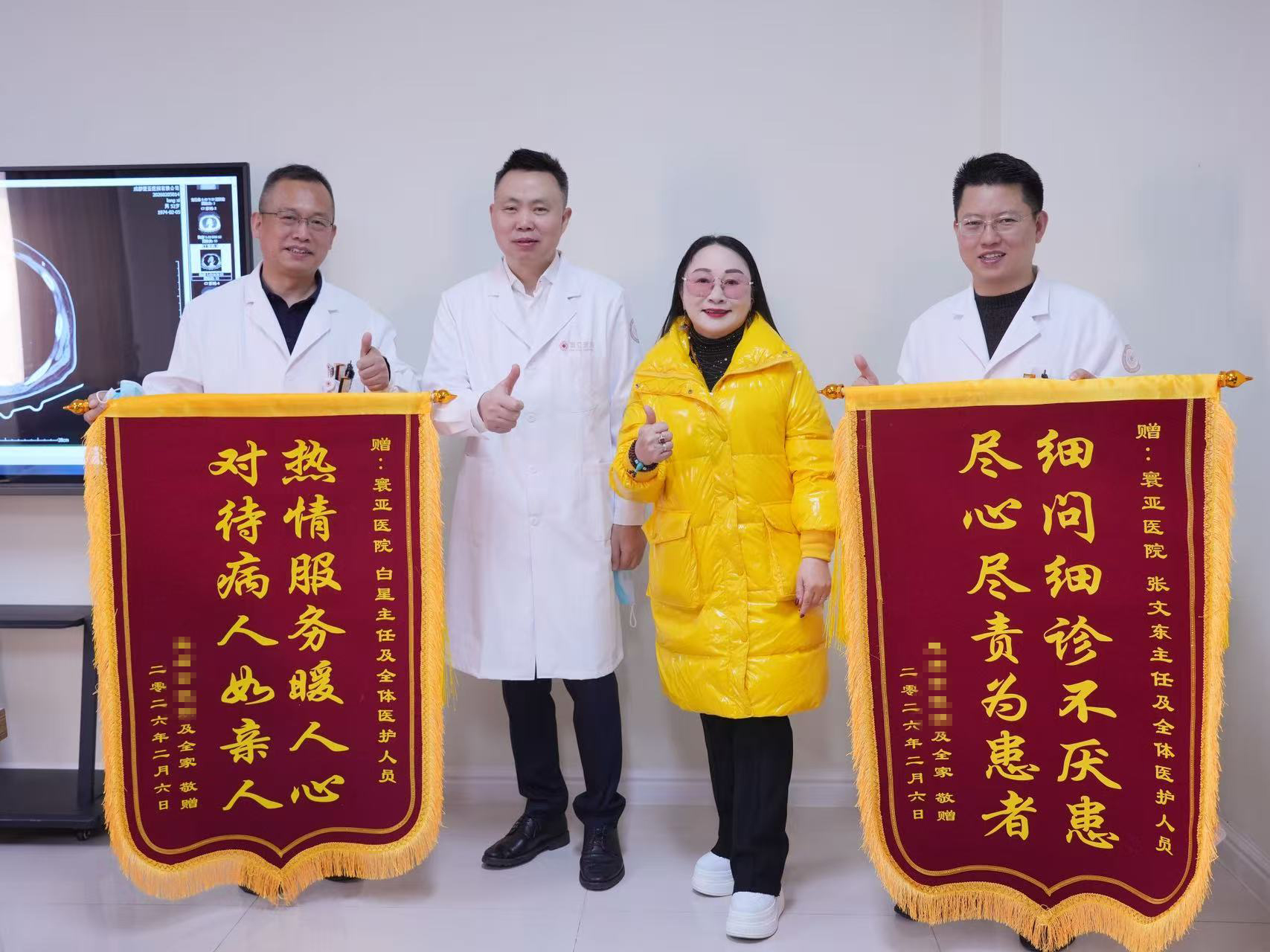
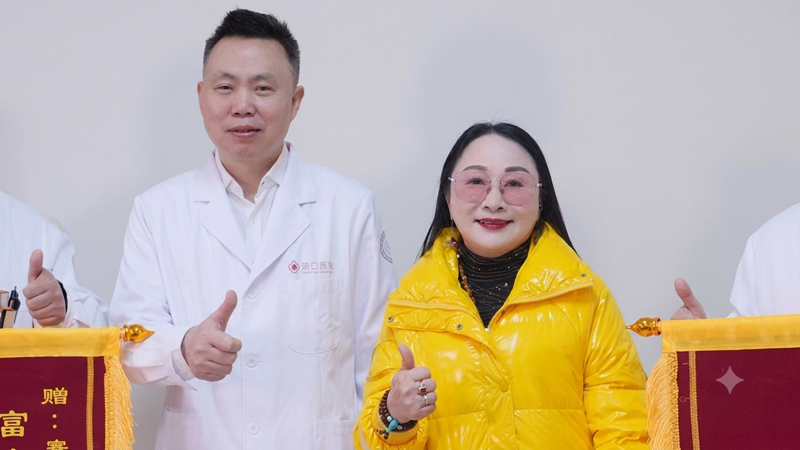
Photo: The patient presenting a silk banner of gratitude to Professor Liao after completing all treatment.
Then came the surgery. After the operation, I was put on chemotherapy. The instant those drugs went in, I felt as if my whole body had been crushed under the wheels of a truck. I threw up violently, so badly that even bile came surging up. My hair fell out in handfuls. My white blood cell count plummeted to rock bottom, and the injections meant to bring it back up made every bone in my body ache, as if ants were gnawing at me from the inside. I barely scraped through one full cycle, only to be told at my follow-up scan—it had come back. Recurrence. That word hit me even harder than the original diagnosis.
What followed were a second surgery, then a third. My belly ended up crisscrossed with scars—vertical, horizontal—like a crumpled, worn-out map. But the cancer cells seemed to have grown legs; they ran wild inside my abdomen and eventually spread to my pelvis. Doctors at several major hospitals flipped through my scans, shook their heads, and said there was no way to operate again—I simply could not survive another surgery. The chemotherapy was stopped as well, because by then my body was so broken down that even the lowest dose of chemo drugs would have overwhelmed me.
During that period, I wasted away to barely over thirty-five kilograms—nothing but skin and bones. My face was sallow and waxy. I needed someone to hold me up just to walk, and I hadn’t the strength left to speak. What tortured me even more was the mental agony. I couldn’t bear to see anyone, couldn’t stand to look at myself in the mirror. I would lie awake night after night, my mind swarming with all sorts of dark, tangled thoughts. My daughter told me later that when I spoke to her back then, my eyes were unfocused, as if I had turned into a stranger.
My daughter, however, refused to give up. Through an online support group for cancer families, she heard about a hospital in Chengdu called Uni-Asia Cancer Hospital—a place that specialized in minimally invasive interventional treatments. Many patients who, like me, had been written off by conventional therapies, had found their answers there. She held up her phone and showed me the hospital’s information: names like Liao Zhengyin, Zhang Jinshan, and Xiao Yueyong came up again and again among patients and their families. These men, they said, were interventional experts who had come from the nation’s top-tier public hospitals, the kind of doctors who could perform procedures that others couldn’t.
“Mom, they don’t cut you open,” my daughter told me. “It’s just a thin tube they thread in from your thigh, all the way to the blood vessels that feed the tumor.” I lay in bed, too weak even to roll over, but those four words—“no need to cut”—sank right into my bones. My body truly could not take so much as one more incision.
The day I arrived at Uni-Asia, I was wheeled in on a wheelchair. Professor Liao Zhengyin took my enormous stack of old films and the latest contrast-enhanced CT, and studied them for a long time against the light box. He didn’t furrow his brow, and he didn’t sigh. Instead, he pointed things out to me carefully: “Auntie Tian, look right here. The blood supply to this recurrent pelvic lesion comes mainly from these branches of the internal iliac artery—the vessels are very clearly visualized. We’ll carry out a pelvic arterial infusion and embolization. We’ll deliver the medicine with precision, and then seal off the vessels. No open surgery, minimal trauma. This is absolutely something we can treat.”
“You mean I can still be treated?” I asked him. That was the very question I had asked in so many other hospitals, and the answer had always been silence or a slow shake of the head. Professor Liao said, “Yes. Let’s take it one step at a time. First, we’ll bring this most active lesion under control.” In that moment, my eyes burned hot with tears.
For that first interventional procedure, I walked into the interventional suite on my own two feet. Lying on the operating table, watching the big DSA machine rotate silently overhead, an unexpected calm settled over me. Professor Liao and his team communicated in quiet voices as they worked. I could catch fragments of what they were saying—“catheter is in position,” “starting perfusion,” “embolization satisfactory”—their tone matter-of-fact yet completely assured. The whole thing took less than an hour and a half. With nothing more than a small bandage at the top of my thigh, I was wheeled back to my room.
The change afterward was something I could barely believe myself. The pelvic area had always been plagued by this heavy, dragging, distending pain. By the very next day, that indescribable aching had noticeably eased. The following morning, I was actually able to sit up in bed all by myself and drink a bowl of millet porridge—the first time in months that food tasted like anything at all. On the third day, leaning on my daughter’s arm, I walked a slow lap around the hospital ward corridor. My legs were still shaky, but my heart, at last, felt steady.
The day I was discharged, I walked out through the main entrance of Uni-Asia Cancer Hospital on my own. My steps were still a little unsteady, but every single one of them landed solid and sure.

Images: Abdominal CT scan at the time of diagnosis, revealing a rectal lesion approximately 15 cm in diameter (Fig. 1). Following arterial interventional therapy at our hospital (Fig. 2), the tumor lesion displays marked sclerosis and necrosis (Fig. 3).
During my recovery at home, I got stronger day by day. I could cook again, go downstairs to buy groceries, and my cheeks finally regained some healthy color. My daughter said my smile now was just like it had been before I ever got sick. And I could feel it myself: the Tian Yufang who had been completely swallowed up by fear and pain was slowly coming back.
All our relatives saw what had happened to me. I have a cousin, three years older than me, who was found to have a serious problem with his pancreas—locally advanced, with complicated blood vessels around the head of the pancreas. Several hospitals were afraid to touch it with a scalpel. His wife called me in tears: he was in so much pain he couldn’t sleep the whole night through; he’d wasted away until he was nearly unrecognizable; they didn’t know what to do.
Without a second thought, I gave them the phone number for Uni-Asia Cancer Hospital. “Just go there,” I said. “That’s the place that gave me my life back.” My cousin was half doubtful, but he could not withstand my relentless urging. Now, they’ve sent his scans and lab reports from our hometown over to Uni-Asia, and Professor Liao’s team is carrying out a preliminary remote consultation. The day before yesterday, my cousin’s wife called to tell me that after he saw my recent photo—looking even more spirited than I did at Chinese New Year—he finally agreed to go to the hospital. She said, “Your cousin says, if you could get well, he wants to give it a try too.”
When I heard that, my heart felt both sore and warm all at once. I know exactly how much I’ve suffered along this journey, and it makes me all the more desperate for the people around me to avoid those same torturous detours. In the past, whenever I heard the term “medical tout,” I always thought it meant something rather unsavory. Yet now, I can’t seem to stop telling anyone who will listen just how remarkable Uni-Asia is—not because anybody hired me, but because these people plucked my life back from the edge. If I kept it to myself, my conscience simply wouldn’t allow it.
At home now, I eat when I’m hungry, sleep when I’m tired, and take a couple of laps around the park every day before doing some tai chi with my old friends. Life has settled back into an ordinary rhythm, but this ordinariness—something I have regained only after nearly losing it—is more precious to me than anything. My cousin is still waiting for the results of his consultation, and I send him WeChat messages of encouragement every single day. “Brother,” I tell him, “trust me, and trust Uni-Asia Cancer. I’ve walked this road myself, and it leads somewhere.”
Chengdu Uni-Asia Cancer Hospital · International Minimally Invasive Tumor Treatment Center
This case recounts a genuine patient experience, shared with privacy protection measures in place. It does not serve as a treatment guarantee.