

- Patient Stories
- Grandma Jia





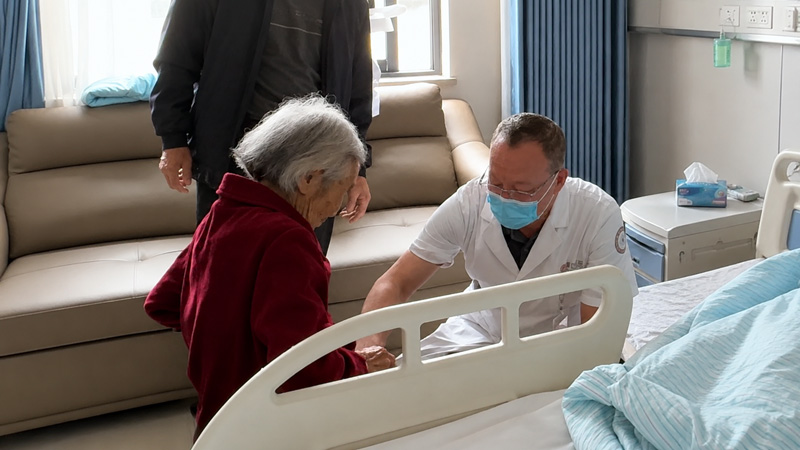
My Stool Finally Turned Yellow – and the Weight Lifted from My Heart: My Two Interventional Treatments at Uni-Asia Cancer Hospital
My surname is Jia. I'm 78 this year, and all the neighbors call me Grandma Jia. My husband passed away early, and I raised three children on my own. The hard years are behind me, and now my grandson is already in college. I've never been particularly talented at anything, but I just can't sit still. Even at nearly 80, I can still shop for groceries, cook, and knit sweaters for my great-grandchildren. But last autumn, this old body of mine suddenly gave me a heavy blow.
First came an unexplained itch all over my body. It itched so badly I couldn't sleep at night, and I scratched red welts all over my skin. Within days, my husband's younger sister came to visit and was stunned the moment she walked in: "Sister, why are your eyes as yellow as a goldfish?" I looked in the mirror and was shocked—not just the whites of my eyes, but my whole face had taken on a yellowish tint, even my palms and the soles of my feet. My urine had turned dark as strong tea. And strangest of all, my stool, which had always been normal, suddenly turned a pale clay color, like crumbled cement.
The children rushed me to the hospital. A contrast-enhanced CT revealed the problem was at the hepatic hilum—the "main valve" of the bile duct—where a growth had blocked the exit route for bile. The doctor called it "hilar cholangiocarcinoma. "I didn't fully understand the term, but seeing my son's eyes instantly turn red, I knew it was no ordinary illness.
The hospital acted quickly and performed a PTCD procedure, inserting a thin tube through my abdomen to drain the accumulated bile. It worked like a charm – within days, most of the jaundice faded, and I wasn't as yellow anymore. But when I asked the doctor what we were going to do next to treat the tumor, he shook his head: "Grandma Jia, the location is too critical. The blood vessels at the hepatic hilum are like a highway interchange—surgery is simply impossible. And at your age, you wouldn't be able to tolerate radiation or chemotherapy either. Keeping the bile duct open with the drainage tube is already the best we can do."
I chewed on those words—"the best we can do"—for a long time, and it felt like a stone was lodged in my chest. The tube hung at my waist, and I carried a bag everywhere. I didn't dare let the neighbors see it, and I was afraid to hold my great-grandson. Life went on, but I felt like I was living on borrowed time, just waiting for the days to pass. What gnawed at me even more was that even though the jaundice had subsided, my stool was still clay-white, which meant the tumor was still blocking the bile from ever reaching my intestines. I didn't say it out loud, but I knew it all too well.
The turning point came when my daughter-in-law found something. She spent days searching on her phone and showed me a hospital called Chengdu Uni-Asia Cancer Hospital. She said they had a team of minimally invasive interventional specialists who had come from China's top public hospitals—Professors Liao Zhengyin and Zhang Jinshan among them. They used a thin catheter inserted into the blood vessels to treat tumors without open surgery. It was minimally traumatic, and many elderly patients who couldn't tolerate surgery had been successfully treated there. My daughter-in-law said, "Mom, they don't just drain the bile—they attack the tumor directly."
"Attack the tumor?" I was a bit confused.
My son explained: "They insert a very thin tube from the groin, thread it through the blood vessels to find the branches feeding the tumor, deliver chemotherapy directly, and then block those vessels to starve it."
When I heard "starve it," I actually felt a small sense of satisfaction.
At Uni-Asia Cancer Hospital, Professor Liao Zhengyin hung my CT images on the lightbox and studied them carefully. He didn't dismiss me just because I was an old lady. Instead, he patiently explained that the opening of the bile duct was being compressed by the tumor, so the bile couldn't flow down, which was why my stool was clay-white. The drainage tube from the other hospital had only released the backed-up bile in the liver, but the root cause was still the tumor. He said my condition could be treated with a procedure that didn't require major surgery—by inserting a thin tube from a blood vessel in the groin, finding the vessels that were feeding the tumor, delivering the drug, and blocking them off to cut off the supply. After one or two sessions, the tumor would shrink, the bile duct would open naturally, and the stool color would return to normal. I didn't remember all the medical jargon, but I heard those five words loud and clear: "The stool can turn yellow."
For that "turn yellow," I decided to grit my teeth and give it a try.
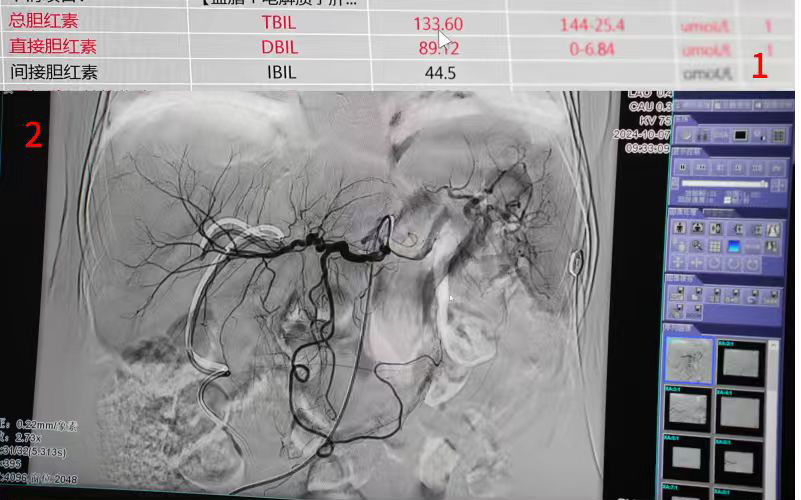
The images show the patient's bilirubin levels upon admission (Figure 1) and the intraoperative image of precise tumor embolization (Figure 2)
For the first interventional procedure, I was wheeled in. Because of my age, the doctors were especially careful. As Professor Liao operated, he gently told me where the tube was, when the drug was being infused, and when the vessel was blocked—his voice steady and reassuring, like a younger relative chatting with an elder. I lay there without much discomfort, and it was all over in less than an hour. That evening, I had some rice porridge and didn't feel unwell. The next morning, the first thing I did was check the bedpan—the color was no longer so clay-white; it had a faint hint of earth-yellow. I quickly called my daughter-in-law over to see, and tears streamed down her face.
A little over a month later, I came back for the second session. This time, I walked into the interventional suite holding onto the wall—I had more confidence. Professor Liao placed the images from both sessions side by side and pointed them out to me: "Grandma Jia, look—after the first treatment, the tumor has already shrunk significantly, and the intrahepatic bile duct dilation has decreased. This time, we'll reinforce the results and clean up any remaining surrounding branches."
On the fourth day after the second session, I went to the bathroom in the morning and looked down—my stool was a proper, healthy banana yellow. Not the frightening yellow of jaundice, but a healthy, moist yellow. I sat on the toilet for a good while, stunned. Then I suddenly laughed, and while laughing, I started crying. The road that had been blocked for over half a year was finally open.
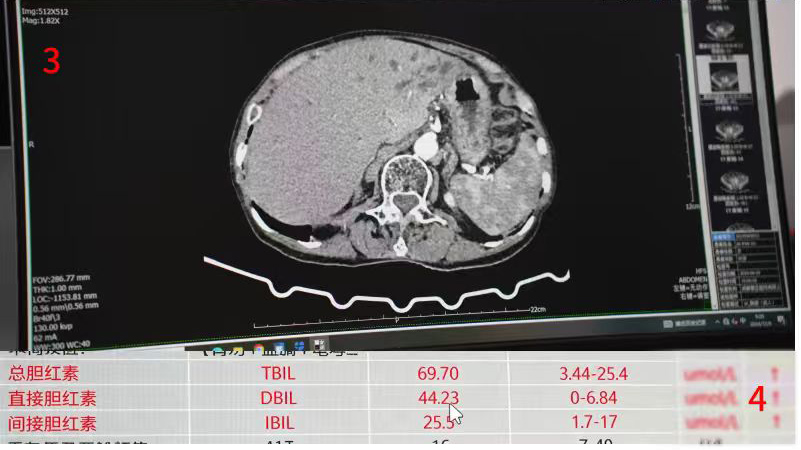
The images show the patient's postoperative abdominal CT findings and bilirubin levels (Figures 3, 4)
The doctor said that now that bile was flowing normally into the intestines, the stool color would naturally return. And with that, my appetite came back too. Before, even the smell of cooking oil made me nauseous. Now I could have a bowl of porridge with a side of pickled vegetables, and gradually I could eat half a bowl of rice. My complexion went from ashen to rosy. One day, I had my son take a photo of the drainage tube site on my waist and send it to Professor Liao. After evaluating it, he said the tube could be removed. The moment it was pulled out, I let out a long, deep breath—like shedding a heavy shackle I'd been carrying for over half a year.
Now I bask in the sun in the neighborhood every day and play a few rounds of mahjong with my old friends, and my great-grandson curls up by my feet while I peel peanuts for him. Everyone says Grandma Jia has turned back into the cheerful old lady she used to be.
A few days ago, I was organizing a drawer and came across a dark-colored top that I used to wear every day during that period—with its collar and cuffs buttoned all the way up to hide my yellow skin. I folded that shirt neatly and put it at the very bottom of the trunk. I never want to wear it again for the rest of my life.
Thank you to Uni-Asia Cancer Hospital and thank you to Professor Liao's team for giving this old boat, which was about to dock for good, a steady push forward. The taste of having my stool turn yellow is sweeter than anything.
Real patient story. Details altered for privacy. Not a guarantee of results.