
- Patient Stories
- Chen De
Six Years Fighting Cancer: I Found the Courage to Go On at Uni-Asia Cancer Hospital in Chengdu
I'm Lao Chen, 54, born and raised in Chengdu. Six years. That's how long I've been living with this condition. And if there's one thing I've learned, it's that some obstacles don't stay in the past—they come right back around to face you.
Back in 2019, when I was first diagnosed with bladder cancer, I didn't take it too seriously, to be honest. I had surgery at the hospital, and after that, they had to pump medicine directly into my bladder — 28 times in total. It's hard to describe the misery of it. The moment I walked out of the bathroom, I'd feel the urge to go right back in. Night after night, I couldn't get a single stretch of solid sleep. But the doctor said this was the price I had to pay to keep my bladder. So I gritted my teeth and bore it.
Five years passed. I thought I had it under control. Then, last October, a follow-up scan brought the news I dreaded—the tumor had recurred, and both of my kidneys were now swollen with backed-up fluid. After a second surgery, I started chemotherapy. Those months were the hardest of my life, the ones I least want to remember. The physical weakness was the least of it. My white blood cell count and platelets both plunged dangerously below the threshold. But what truly broke me was my teeth. They began to darken, to soften, and then they crumbled—like chalk. Not one or two. All of them. My body was telling me, loud and clear, that it couldn't take any more. So I talked it over with my family, and we decided to stop the remaining treatments.
Earlier this year, everything took a sudden turn for the worse. It started when I could no longer urinate. Even inserting a catheter was excruciating—I was trembling from the pain, and it took several attempts before it could finally be placed. But that was only the beginning. Once the catheter was in, the problems kept coming. I suffered repeated episodes of blood in my urine and one urinary tract infection after another. I went from hospital to hospital for intravenous antibiotics, but nothing seemed to help.
Then the pain set in. There was a constant dull ache in my lower abdomen, while my lower back and the outside of my thigh felt as if they were being stabbed with needles. I started with one painkiller at a time, then two. Before long, I needed another dose every three or four hours. Eventually, even the medication no longer seemed to provide much relief.
After a multidisciplinary consultation at a major hospital, the specialists recommended that I consider having my bladder completely removed. My family and I spent days wrestling with the decision, turning it over again and again. In the end, I couldn't agree to it. It's not that I didn't trust the doctors. It's just that after two rounds of surgery and everything I'd been through with chemo, I knew better than anyone what this body could and couldn't take. I was afraid that if I went in for that surgery, I might never come out.
I searched everywhere online, desperately looking for something—anything—that might give me hope. By chance, I came across Uni-Asia Cancer Hospital and learned that Professor Liao Zhengyin was practicing there. I read that my condition could be treated with minimally invasive interventional therapy. I didn't hesitate for a second. I was admitted to Chengdu Uni-Asia Cancer Hospital almost immediately.
To be honest, when I arrived, I felt completely defeated. It was as if all the color had drained out of my life. During that time, I barely responded when my family tried to talk to me. It felt like there was a heavy stone pressing on my chest, making even the simple act of breathing seem exhausting.
After I was admitted, the examinations showed that my condition was even more complicated than I had imagined. A new lesion had been found in my liver, which was suspected to be a metastasis. There were also several small spots in my lungs that still needed further evaluation. The most challenging problem, however, was a blood clot in my abdominal aorta.
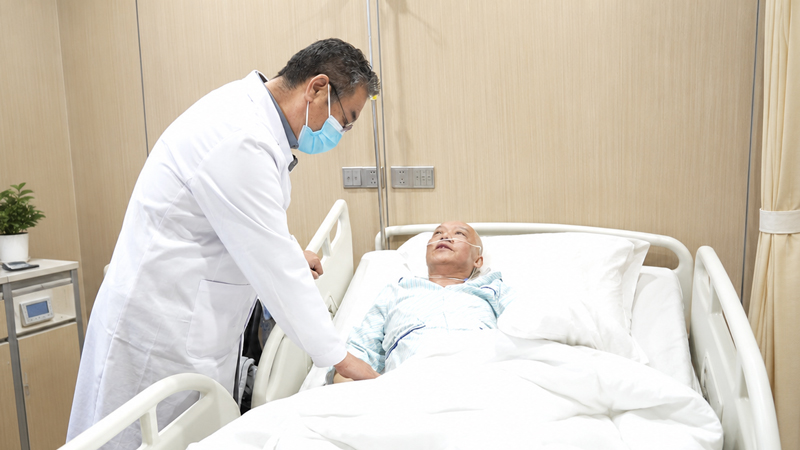
Before I signed the consent form for the procedure, Professor Liao Zhengyin came to my room to speak with me. He placed my scans on the lightbox and carefully walked me through them, pointing to each area one by one. He explained that the blood clot was like limescale building up inside a water pipe, meaning the procedure would have to be performed with extreme care to avoid disturbing it.
When he finished explaining everything, he looked at me and asked if I was afraid. I told him, "Of course I'm afraid—but I'm even more afraid of doing nothing."
He gently patted me on the shoulder and said, "Don't worry. I'll do everything I can for you."
He spoke calmly and reassuringly, just like a family member would. Somehow, those few words untangled the knot of fear and anxiety that had been weighing on my heart.
I understood all the risks, every single one. But I signed anyway. Because when I weighed it against the thing growing wildly inside me, I was willing to roll the dice.
On the afternoon of the procedure, I went in wide awake. Professor Liao explained it to me: they would make a tiny opening at the top of my thigh, guide a catheter along my blood vessels, and go directly to where the tumor was growing. They'd deliver the drug and, at the same time, seal off the pathways feeding it blood. I can't say I understood exactly how it all worked, but I remember lying there, hearing Professor Liao's voice every now and then, soft and steady: "Everything's going smoothly." "Don't be afraid. It'll be over soon." His hands moved with such steadiness and care, his full attention fixed on the screen. Occasionally he would say a few words to the nurse beside him—quietly, but absolutely assuredly. With him there by my side, my shoulders, which had been tensed tight, slowly began to relax. I felt hardly any pain. In less than an hour, I was wheeled out.
After I returned to my room, my only job was to lie still. The doctor instructed me to keep my leg straight without moving it for several hours, and the compression over the puncture site had to stay in place for at least two hours. Surprisingly, I didn't find it difficult. After everything I'd been through over the past few months, simply lying in bed almost felt like the easiest part.
The next day, when the dressing was removed, the puncture site was clean. There was no bruising, and I could feel the pulse on the top of my foot. Seeing that, I finally let out the breath I'd been holding. For the first time in a long while, I felt that a weight had been lifted off my shoulders.
Strange as it may sound, from the day they took off that dressing, the clogged-up feeling in my chest seemed to ease a little, too. During those first few days in the hospital, I barely spoke. When my wife brought me meals, I'd only manage a couple of bites. But the afternoon after my procedure, I actually turned to her and said I felt like having some rice porridge. I even chatted with her a bit about our granddaughter and how she was doing at school. My wife told me she could see a little light back in my eyes—not the dull, lifeless look I'd been carrying around the days before. I could feel it, too. It wasn't that my body had suddenly recovered in some dramatic way. It was more that the feeling of "all I can do is just endure this" had finally lifted. Coming to Uni-Asia Cancer this time, at least I made a decision that was my own. And it actually worked. Once a person has something to look forward to, their whole spirit changes.
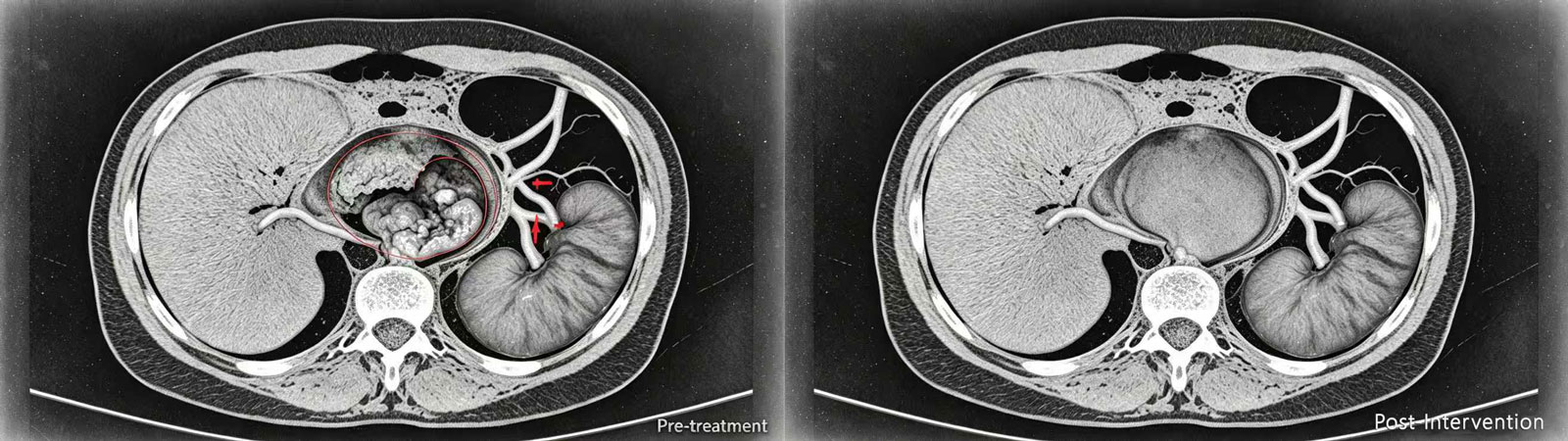
The image shows the CT imaging of the bladder lesion at the time of patient admission (left) and the follow-up CT imaging after completion of all treatment (right)
On the day I was discharged, Professor Liao gave me a long list of instructions: don't overexert yourself; don't stay up late; no alcohol; keep up with your nutrition; and get a blood test once a week. He stressed one thing in particular — the blood clot in my blood vessel needed to be monitored regularly by a vascular specialist, and if anything felt off in my legs or feet, I was to get to the nearest hospital immediately.
When I walked out of the hospital with my discharge papers in hand, I felt a quiet calm settle over me. It's not that I think my disease is cured—I'm still carrying a list of diagnoses, every one of them heavy. But at least this time, when the hurdle rose up in front of me, I chose a path I could actually walk.
I'll go home, recover a bit, and then head back for my next round of treatment. It's still a long road ahead. But at least now I know where my next step is headed.
Real patient story. Details altered for privacy. Not a guarantee of results.