

- Patient Stories
- Gao De

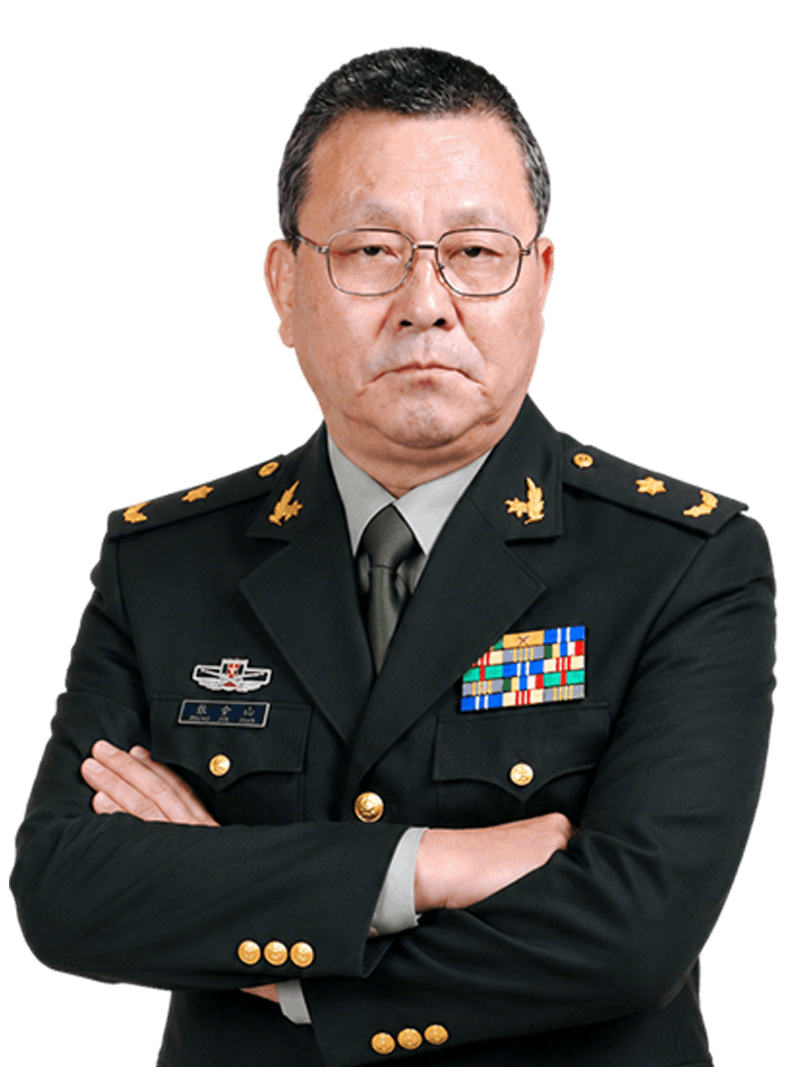



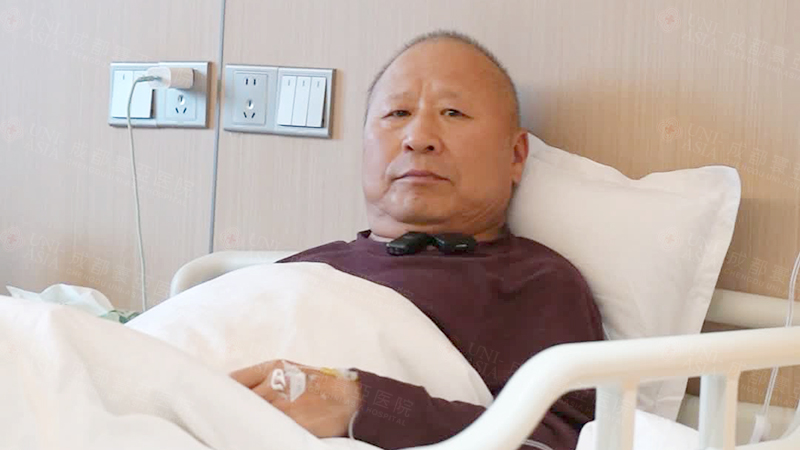
The Hurdle Deep in the Pancreas—Finally, No Scalpel Needed
My name is Gao De. I'm sixty years old and just retired. I had planned to take my wife to all the places we'd never been while my legs could still carry me—but life had other plans.
After autumn set in this year, I kept feeling discomfort in my stomach. I'd get bloated after eating, had a dull ache in my back, and lost a noticeable amount of weight. At first, I thought it was just a flare-up of stomach trouble. I bought a few boxes of antacids from the pharmacy and took them for half a month—no effect at all. My son practically dragged me to the hospital for a contrast-enhanced CT. When the report came out, everyone's face went pale—there was a growth in the lowermost, winding corner of my pancreas. Pancreatic cancer.
The doctor said the pancreas is shaped like a pear with a long stalk. My tumor happened to be lodged right in that most hidden bend beneath the stalk—a spot already buried deep in the abdomen, surrounded by the body's largest blood vessels like an overpass of layered traffic. The tumor wasn't just sitting there; it had wrapped itself around those critical vessels.
"The scalpel can't go in here," the doctor said, pointing at the scan. "Look – the artery feeding the intestine and the vein returning blood to the liver are both encased by it. Operating here is like trying to dismantle something in the middle of a tangle of water pipes. If you nick the wrong one, it's lights out on the table."
I asked about chemotherapy. He sighed and said we could try, but pancreatic tumors in this location aren't very sensitive to chemo drugs—the results were uncertain.
Over the next two months, I went through two rounds of chemotherapy. To be honest, I don't want to relive that experience—I couldn't eat, had no energy, and my hair fell out in clumps. But when we repeated the CT scan, the tumor hadn't budged an inch. It was like it had been welded in place. Even the oncology doctors were stumped. They called my son into the office and implied, in so many words: we've tried the conventional options with poor results—it's time to think outside the box.
My son went crazy searching for information during that time. One night, he pushed open my door, his eyes bright: "Dad, I found something. It's called Nanoknife."
He handed me his phone, and it showed Uni-Asia Cancer Hospital. He said it was an international high-end cancer hospital that primarily treats foreign patients, and it had gathered a group of China's top minimally invasive interventional experts—names like Xiao Yueyong, Zhang Jinshan, and Liao Zhengyin, all well-respected in the field. Most importantly, they offered a technology called "NanoKnife," specifically designed to target tumors that wrap around major blood vessels and can't be surgically removed.
"No bleeding," my son said. "And it doesn't damage the vessels."
When I heard that, the dim light in my heart flickered back to life.
When I arrived at Uni-Asia Cancer Hospital, Professor Xiao carefully reviewed my scans, then sat down beside me, picked up a pen, and started drawing on a piece of paper. He drew a curved pear shape, marked a small circle at the lowest bend, and added several thick tubes running alongside it.
"Mr.Gao, here's your pancreas, and this little bend is where the tumor is nesting. These thick tubes are the main arteries from your heart and the major veins returning to your liver—and they're tightly entangled by the tumor. Cutting with a scalpel would be like trying to untie a knot right in the middle of these pipes—no surgeon can get in there safely." Then he drew several small crosses around the circle: "Nanoknife doesn't use heat or cold. It uses electricity. We insert several thin electrode needles through your abdominal skin, guided precisely by CT, positioning them around the tumor's perimeter. Then we deliver high-voltage electrical pulses. These pulses create nanoscale pores in the tumor cell membranes—punching holes through them and causing them to die. The key is that blood vessels, bile ducts, and other structures don't have the same type of cell membranes, so the electrical pulses leave them untouched. It's like burning out the copper wire inside the insulation while leaving the outer sheath completely intact."
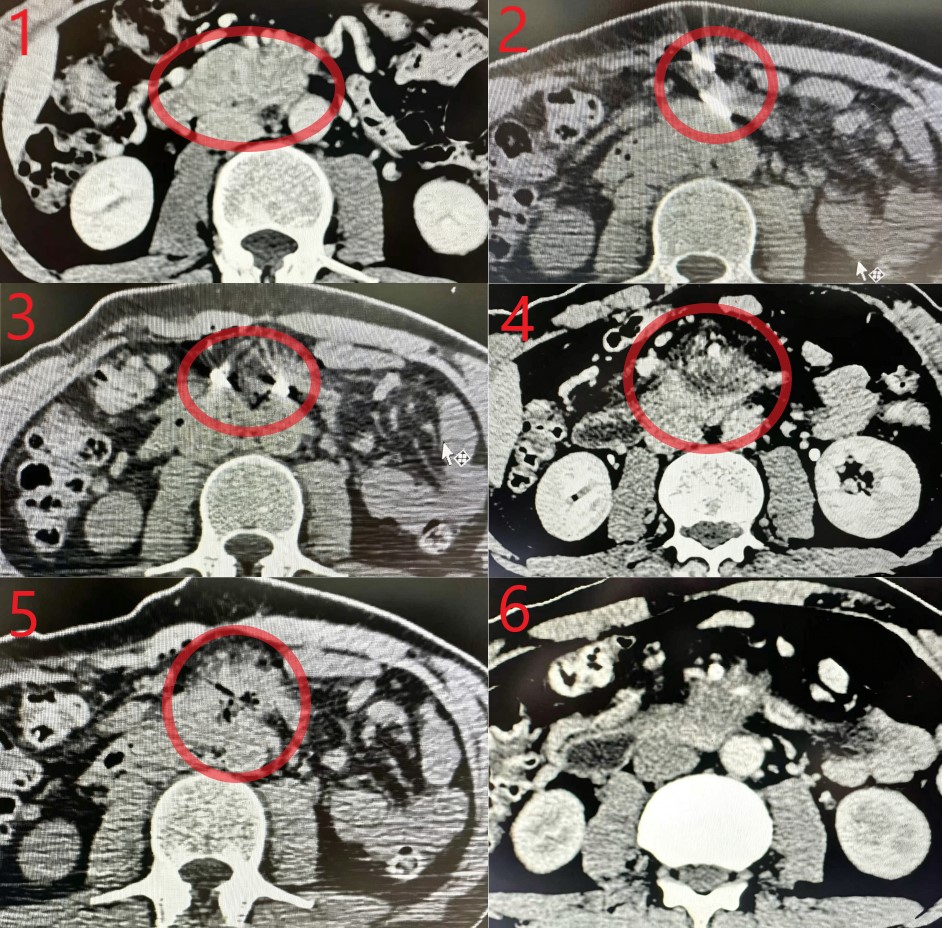
Image: Preoperative CT showing the pancreatic tumor (Fig. 1), intraoperative needle placement (Figs. 2 & 3), and post-procedure CT showing complete tumor disappearance
I asked if it hurt. He said it was done under local anesthesia, I'd be awake throughout, and there wouldn't be much sensation.
I also asked if they could get it all. He looked at me and said, "Your tumor is still confined to that corner; it hasn't spread. Nanoknife is the ideal approach for this situation. I'm confident."
On the day of the procedure, I walked into the interventional suite myself. After I lay down, Professor Xiao guided several tiny electrode needles through small punctures in my abdomen, precisely positioning them around the tumor under CT guidance. On the screen, I could see the needle tips gradually reach their positions, avoiding the thick blood vessels and tightly encircling the tumor. Throughout the process, he kept talking to me calmly: "This needle is in... the ablation zone is well covered... still safely away from the vessels."
During the few seconds of ablation, I felt no heat and no cold—just a slight vibrating sensation, and then it was over.
Afterward, I asked, "How much blood did I lose?"
Professor Xiao smiled and said, "Your procedure barely bled at all."
The next day, I had a follow-up CT. Professor Xiao called my son over as well, pointed at the images, and said, "Look here – this entire area where the tumor used to be now shows no enhancement at all. The ablation is perfect. And not a single surrounding vessel was damaged."
My son stood in front of the lightbox for a long time without saying a word. His eyes turned red.
I didn't stay in the hospital long. I was discharged in just a few days. Now I'm recovering at home. My appetite is getting better every day, and color has returned to my face. A couple of days ago, I even told my wife: when I'm fully recovered, let's take a trip to Dujiangyan first—it's not far, and it'll be good for stretching my legs.
The Nanoknife has no blade, but it pulled me back from a dead end. Thank you to Professor Xiao and his team—and thank you to my son for not giving up. I don't dwell on what lies ahead. If I can hold my wife's hand and walk steadily for a while longer, that's enough.
Real patient story. Details altered for privacy. Not a guarantee of results.